

What is my purpose? Human beings have asked some variation of this age-old question since the beginning of time. There are some people who seem to be born knowing exactly what their purpose is. They wake up in the morning knowing precisely what they were born to do and they go do it. For others (like me!), the answer to this question seems to be much more elusive. Finding our purpose is a much longer journey of discovery and refinement. And over the last year, I’ve been on this journey of discovery.
For so long, I have known that I tend to gravitate towards certain roles, situations or endeavors. But if I’m being honest, I have lacked clarity in the overarching purpose or the “why”. Yet the why is essential, as it becomes the filter through which we make decisions, what we say yes to and what we say no to, and the things we choose to prioritize. It shapes the trajectory of our lives and who we become over a lifetime.
In the book of Ephesians, Paul reminds us:
For we are God’s handiwork, created in Christ Jesus to do good works, which God prepared in advance for us to do. (Ephesians 2:10)
So what does it mean to be God’s handiwork – His masterpiece – created in Christ Jesus to do good works? And how can we take steps to discover what those good works are that He has prepared in advance for us to do?
As I’ve been wrestling through these questions, there are a few practical tools I have found to be immensely helpful. In today’s post, I want to share these tools with you in the hopes that they may be helpful for you as well, as we embark on this journey of discovery together.
Identify What Makes You Feel Alive
The first exercise I have found helpful in this journey of discovery is to identify what makes me feel most alive. Finding clues in the things we are already actively doing often helps to point us in the direction of what our broader purpose is. Here are some questions that can help us find these clues and identify what in life makes us feel most alive:
When do you lose track of time?
Consider what pull you in so deeply that hours just seem to disappear – the activities or work you can engage in for hours, but it feels like only a few minutes have gone by because you are so focused and immersed in what you are doing.
What types of conversations energize you?
Consider what conversations seem to fuel you and give you joy, life, energy and excitement. Some examples could include conversations about life, theology, faith, creativity, new ideas, problem solving, helping others process emotions or making plans for something.
What do people often come to you for help with?
Consider the things that people come to you for help with, both practically and/or relationally. What are the things that others seem to think you are capable of or roles that you are asked to help serve in?
What kinds of problems in the world bother you the most?
Consider the injustices or brokenness you see in the world that stir your heart and compel you towards action. What are the problems in the world that deeply move you emotionally?
What activities make you feel deeply satisfied afterward?
Consider the work or activities you engage in and feel deep satisfaction by, even if (or perhaps especially when) they take extraordinary effort.
It is important to not overthink the answers to these questions, but to answer honestly and instinctively. Clarity in these areas can give us clues to what gives us energy and joy in life, identify those moments in life when we feel most alive, and ultimately point us in the direction to discovering our purpose.
Find the Golden Thread
Another tool that has helped to guide me in looking forward towards my purpose, has been to reflect back upon my life and trace the “golden threads” throughout. These golden threads are themes God has woven throughout our lives that have helped to shape us. Sometimes reflecting back upon our life as a whole can help us see these threads more clearly.
Finding these golden threads is most often done through creating a life timeline and reflecting on key moments that have helped to shape our lives. Begin by drawing a horizontal line on a blank page and divide the line into increments spanning from 0 to your current age. Thoughtfully and prayerfully reflect back upon your life and mark the following milestones or memories on your timeline:
- What are some moments in your life that have felt especially meaningful or shaping?
- What difficult or painful experiences have helped to shape who you are?
- What are some meaningful risks have you taken that you have felt proud of or have shaped who you are?
- What are some of the key seasons of growth you have experienced?
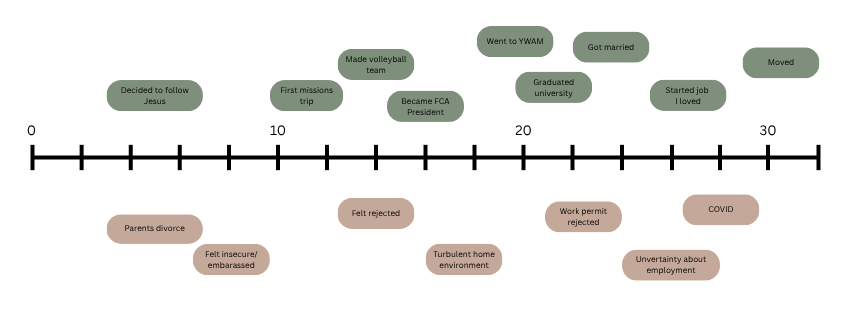
I encourage you to not rush this activity, but let it be an ongoing reflection with time and space to let these questions marinate. You may find that while some memories come to mind in the moment, others may come to you throughout the rest of your day or week. Simply write down any memory that comes to mind and feel free to give it some time before moving on.
After writing down the memories that come to mind, reflect on your life timeline and consider the deeper story being told throughout. Here are some questions that can help bring further clarity to the “golden threads” God has been weaving through your life all along:
- What themes, patterns or desires seem to repeat themselves throughout your life?
- What have your hardest or most painful experiences taught you?
- When in your life have you felt the most proud of the kind of person you were becoming, not just what you accomplished?
- If you imagine yourself at 80 years old looking back, what would make you feel like your life truly mattered?
- When have you felt most alive, engaged, or aligned with who you were created to be? In those meaningful moments, what did you deeply care about or how were you impacting others?
- Where can you see God’s hand guiding, shaping or redeeming your story, even in ways you didn’t recognize at the time?
As you reflect on these questions, summarize the “threads” you see in a few words or phrases.
Shape Through Scripture
Last, but certainly not least, a final tool that has been helpful for me in discovering my life’s purpose has been to reflect on the Word of God and how my life fits into the larger context of God’s story. This process of reflection helps to further shape and refine our purpose by anchoring it in both who God is and who He created us to be.
Begin by writing out any verses, passages or even quotes that have spoken to you over the years or impacted you in some way. As you reflect on these scriptures or quotes, here are some questions to consider:
- What key words, phrases, and themes emerge out of these verses?
- What do they say about who God is and His character?
- How do they speak to why God created me and what His purpose for me is?
Once again, I encourage you to take your time with this. Ask the Lord to bring verses to mind and feel free to let these questions percolate over a few days or even weeks.
Next Steps
At this point, you may be feeling both clarity and tension: clarity in what you’ve seen through these exercises and tools and tension in what to actually do with these insights. Here is the good news: your purpose is not something you need to “figure out” quickly, but rather something you can begin to recognize and respond to over time.
We are also not meant to do this alone. Share your responses and reflections to these exercises with a close family member, friend or mentor who knows you well and loves you. Ask them what they see in you and what common themes they see through your responses to these questions.
As you reflect on what gives you life, the story that has shaped you, and what God has revealed to you in His Word, you may begin to notice where they intersect. Purpose often lives at the intersection of these three things. Rather than trying to define it perfectly at this point in time, though, simply ask where these themes are already showing up in your life and choose one area to lean into.
From there, take one small, intentional step towards living into that purpose. If you feel your purpose may include mentoring, mentor one person. If it may involve teaching, host a small workshop. If it may involve building community, invite people over.As you do, pay attention to what feels life-giving, where you see fruit, and when you sense the Lord’s presence most clearly.
Clarity of purpose often comes gradually, not all at once. Your purpose is something that is revealed as you remain rooted in Christ and it is lived out through small, faithful steps over time. You are indeed God’s handiwork, created in Christ Jesus to do good works, which God has prepared in advance for you to do.

 This Darling Adventure
Interesting!
LikeLike